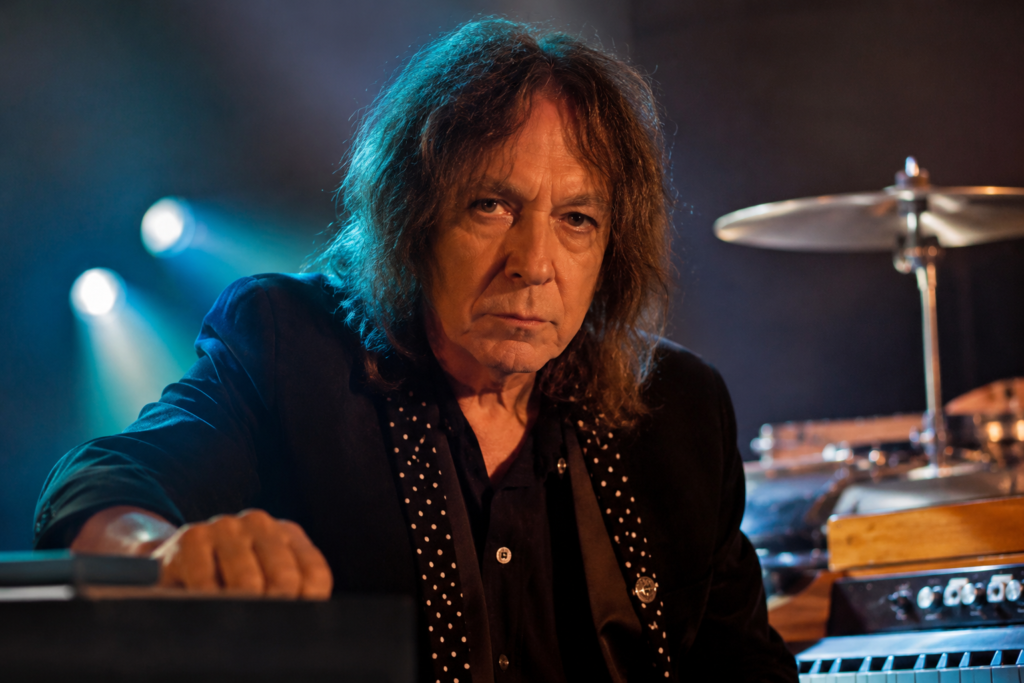
Jeff Conolly, the Boston rock frontman known as “Monoman” who led the garage rock band Lyres for nearly five decades, died July 31, 2026, at his home on the North Shore. He was 69. Conolly had been undergoing treatment for bladder cancer, including chemotherapy and surgery, in the months before his death.
Conolly built his reputation as the singer, organist, and sole constant member of Lyres from 1979 onward, following an earlier stint fronting the proto-punk band DMZ. His raw, organ-driven take on 1960s garage rock earned him a devoted following in Boston and an even larger one in Europe, where fans treated him as rock and roll royalty. He is survived by his wife, Stevie Gomez.
Who Was Jeff Conolly
Conolly grew up in Connecticut, following early childhood years in Albany, New York, and near Pittsburgh, Pennsylvania. He moved to Boston in the mid-1970s to attend Boston University but left his studies after music took over. By 1976, he was fronting DMZ, a high-energy band that mixed Stooges-style intensity with garage rock roots and British Invasion melody.
DMZ became a fixture at Boston clubs including the Rat, opened for the Ramones and the Jam, released an independent EP, and signed to Sire Records for a self-titled debut album in 1978 before breaking up.
From DMZ to Lyres
After DMZ dissolved, Conolly formed Lyres in 1979 with several former DMZ members. The new band moved away from punk speed toward a leaner sound built on rhythmic interplay, fuzz guitar, and driving organ riffs, drawing heavily on 1960s garage rock and the Kinks. Conolly sang and played a Vox Continental organ with one hand while pounding a tambourine against his thigh with the other.
He earned the nickname “Monoman” for his devotion to monaural 1960s recordings and his insistence on exact, faithful arrangements. He later asked friends to call him simply Jeff after his second marriage, though the nickname stuck in music circles. His stage shows were intense and sometimes chaotic. He once broke a beer bottle over his own head during a New Haven performance and kept playing.
Signature Sound and Discography
Lyres became a fixture at the Rat and built a catalog centered on Ace of Hearts Records, a Boston label. Early singles including “Buried Alive,” “How Do You Know,” and “Don’t Give It Up Now” established a reverb-heavy, urgent sound. The 1983 single “Help You Ann” later ranked 13th on a magazine list of the greatest Boston songs of all time, and “Don’t Give It Up Now” remains the band’s best-known track.
| Release | Year | Label | Notable tracks |
|---|---|---|---|
| AHS 1005 (EP) | 1981 | Ace of Hearts | “Don’t Give It Up Now,” “How Do You Know?” |
| On Fyre (LP) | 1984 | Ace of Hearts | “Help You Ann,” “She Pays The Rent” |
| Lyres Lyres (LP) | 1986 | Ace of Hearts | “Someone Who’ll Treat You Right Now” |
| A Promise Is a Promise (LP) | 1988 | Ace of Hearts | — |
| Happy Now (LP) | 1992 | Impossible/Taang! | “We Sell Soul,” “Get Any Bar” |
The 1984 album “On Fyre” marked the band’s commercial and critical peak and was described at the time as the beach-party album of the year. Beyond the three core studio albums released on Ace of Hearts, Lyres also put out numerous EPs, singles, and live recordings, though Conolly remained selective about new studio material in later years.
Music writers have credited the band’s loud-quiet-loud dynamics with influencing the Pixies, who rose from the same Boston scene, and pointed to a broader ripple effect on college rock and alternative music that followed.
A Demanding, Beloved Bandleader
Conolly cycled through roughly 30 different lineups of Lyres over more than four decades, often losing or firing bandmates who could not meet his standards. He remained the band’s only permanent member throughout its existence.
Clint Conley, a childhood friend from Connecticut and bassist for Mission of Burma, called Conolly “the only person I’ve ever been in a band with that I wanted to strangle,” while also describing him as a musical genius. Lilli Dennison, who booked Lyres for years at the Rat, said Conolly “could be incredibly sweet and helpful, but also wicked and selfish and diabolical.”
Friends and fellow musicians, including drummer Jon Wurster and guitarist Deke Dickerson, have shared similar stories that mix admiration with exasperation, reflecting the polarizing personality that shaped his reputation across nearly 50 years in music. Outside the stage, Conolly stayed connected to Boston’s music community by working for years in local record stores.
Cancer Diagnosis and Final Months
Lyres played what turned out to be their final show on February 13, 2026, at the Carousel Lounge in Austin, Texas, backed by guitarist Bob Schena, bassist Kevin Pinkham, and longtime drummer Paul Murphy. Conolly’s bladder cancer diagnosis became public in early 2026, leading to the cancellation of a planned spring tour.
A GoFundMe campaign was launched to help cover his treatment costs, ultimately raising more than $78,000. On March 12, 2026, the Boston music community held a benefit concert at the Middle East in Cambridge, featuring performances from Mission of Burma, the Dogmatics, Classic Ruins, Unnatural Axe, and the Flies. Conolly made a surprise appearance that night, joining Mission of Burma for a brief, chaotic cover of the Stooges’ “1970.”
In the weeks leading up to his death, Conolly told friends he was recovering and sounded optimistic, and people close to him said he appeared to be on the mend in late July. His decline in his final days came as a surprise to those who had spoken with him recently. He died at home on the North Shore on July 31, 2026. His wife said in a statement that she was “still in shock and trying to process” his death.
Legacy
Lyres never achieved a major commercial hit, but Conolly’s insistence on raw, organ-driven garage rock kept a distinctly 1960s sound alive through the punk, indie, and alternative eras. His catalog remains a reference point for fans of the garage revival, and his influence surfaces in bands that absorbed his tension-and-release songwriting approach even without direct knowledge of his work.
Those who worked with him remember a contradictory figure: exacting and volatile on one hand, generous and deeply devoted to the music on the other. That combination, sustained across nearly 50 years and dozens of lineup changes, defined his standing as one of Boston’s most distinctive and enduring rock frontmen.
Related Reading: [Brittany Boltinhouse Dethroned as Miss NC USA 2026]