
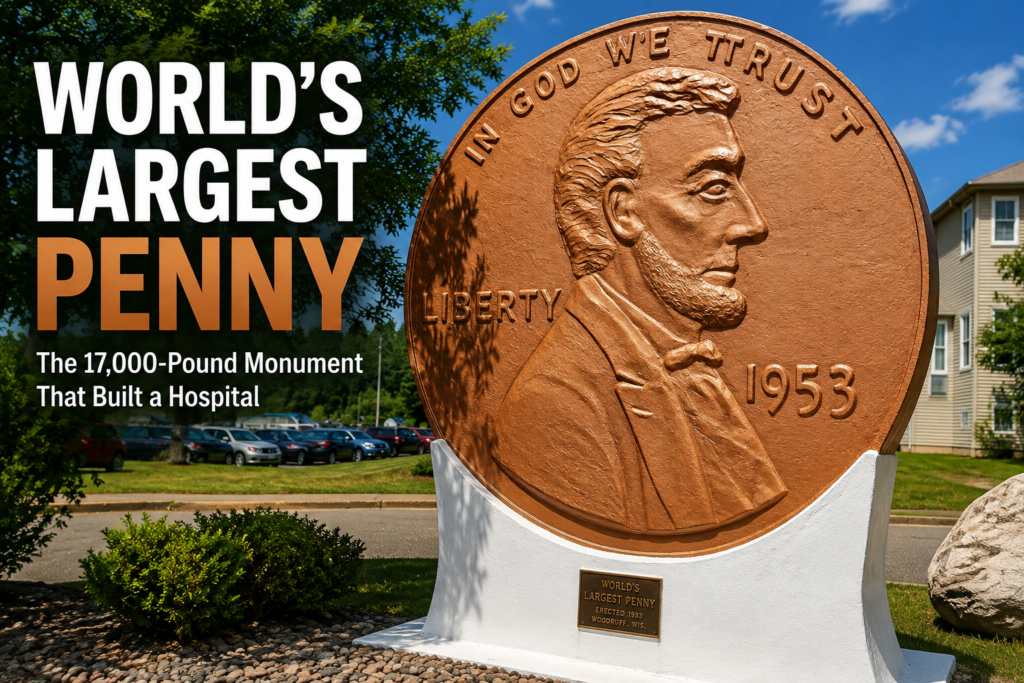
The world’s largest penny is a 17,452-pound concrete monument in Woodruff, Wisconsin, built to honor a student-led fundraising drive that helped build the town’s first hospital. As of early 2026, cracks in the aging structure forced volunteers to cover it with a tarp while the Dr. Kate Museum and Historical Society raises money for a permanent shelter to protect it.
The monument measures 10 feet in diameter and 18 inches thick, according to the official Wisconsin Historical Society marker, the most precise public record of its dimensions. It depicts a 1953 Lincoln cent and sits at the corner of 3rd Avenue and Hemlock Street in Woodruff, near a former school site now home to an assisted-living facility.
A Doctor Who Delivered Babies by Snowshoe
The story behind the penny starts with Dr. Kate Pelham Newcomb, a physician who began practicing in remote northern Wisconsin in the 1930s. Known as the “Angel on Snowshoes,” she made house calls by canoe, ski-equipped Model T, or snowshoes across terrain that was often impassable by ordinary vehicle. Over her career she delivered an estimated 3,000 to 4,000 babies and treated thousands of patients who had no nearby hospital.
By the late 1940s, Newcomb was pushing for a local hospital. Ground broke in 1952, but the project stalled when funding ran out.
A Geometry Lesson Turns Into a Fundraiser
The breakthrough came from an unlikely source: a math classroom. Otto Burich, a geometry teacher at Arbor Vitae-Woodruff School, asked his students what one million of something would actually look like. The class settled on pennies and decided to collect one million of them to help fund Newcomb’s hospital.
Students mailed letters to newspapers, alumni, and strangers across the country asking for spare change. Younger children donated their allowances. In 104 days, the campaign collected 1.7 million pennies from all 48 states. On Memorial Day 1953, about 10,000 people attended the Million Penny Parade in Woodruff, filling the school gymnasium with coins.
National television gave the effort a second wind. On March 17, 1954, Newcomb appeared as a surprise guest on “This Is Your Life.” Viewers responded with more than 1.3 million additional pennies and cash donations totaling over $100,000. Lakeland Memorial Hospital, later renamed Howard Young Medical Center, opened that year with Newcomb serving as chief of staff.
Weeks after the hospital opened, the town dedicated the giant concrete penny on May 29, 1954, as a permanent tribute to the students and donors who made it possible.
Monument Specifications
Public descriptions of the monument have varied slightly over the years, but the Wisconsin Historical Society marker offers the most authoritative figures.
| Attribute | Specification |
|---|---|
| Diameter | 10 feet (3.05 meters) |
| Thickness | 18 inches |
| Weight | 17,452 pounds (about 8.7 tons) |
| Material | Painted concrete block |
| Design | 1953 Lincoln cent obverse |
| Dedicated | May 29, 1954 |
Some tourism materials list the monument at roughly 15 feet tall, including its base, or describe the thickness as 12 inches. Those figures do not appear on the official historical marker, which lists only diameter, thickness, and weight.
Ownership and Ongoing Preservation
The monument originally belonged to the hospital it helped fund. Ownership transferred to the Dr. Kate Museum in 2018. The museum, housed in Newcomb’s former medical office a short walk from the monument, displays her medical equipment, photographs, and memorabilia from the penny campaigns. Students continued collecting pennies for years afterward to support a memorial scholarship.
By late 2025, more than 70 years of Wisconsin weather had left the concrete monument with significant cracking. Museum vice president Cy Timmens said the structure, built from painted cinderblocks and concrete, carries historical value that goes beyond tourism appeal. Volunteers wrapped it in a dark green tarp and launched a fundraising campaign for a permanent all-weather shelter estimated to cost $30,000.
The monument remains visible from the street while covered, and local interest has continued despite the temporary tarp. The Dr. Kate Museum offers deeper context on Newcomb’s life and the penny campaigns for visitors who want the full history.
Not a Formal World Record
Despite its name, the Woodruff penny is not a Guinness-recognized record holder among oversized coin replicas. Canada’s Big Nickel, a roadside monument in Sudbury, Ontario, is larger overall. The Wisconsin penny nonetheless remains the best-known oversized American penny and a documented community landmark, distinct from record-setting attempts tied to other coin denominations.
Why the Timing Matters
The preservation push comes as the actual U.S. penny disappears from circulation. The U.S. Mint struck its final circulating pennies in 2025 after the Treasury Department determined that production costs had exceeded the coin’s face value. Existing pennies remain legal tender, but the Mint has stopped minting new ones for everyday use.
That shift gives the Woodruff monument added significance. It stands as one of the most visible physical reminders of a coin that no longer rolls off the Mint’s presses, built decades earlier by a small town that turned spare change into a hospital.
Visiting the Monument
The penny sits outdoors at the corner of 3rd Avenue and Hemlock Street in Woodruff, within Oneida County, and remains viewable year-round from the street. The Dr. Kate Museum, located a short walk away in Newcomb’s former office, provides additional historical materials on the 1953 and 1954 fundraising campaigns.
The monument’s story ties together a rural doctor’s decades of service, a classroom math exercise, and a nationwide wave of small donations that produced lasting infrastructure in a small Northwoods town. The current preservation effort aims to keep that concrete tribute standing as the coin it represents fades from daily use.
Related Reading: [15 Whimsy Date Ideas to Break Everyday Monotony]