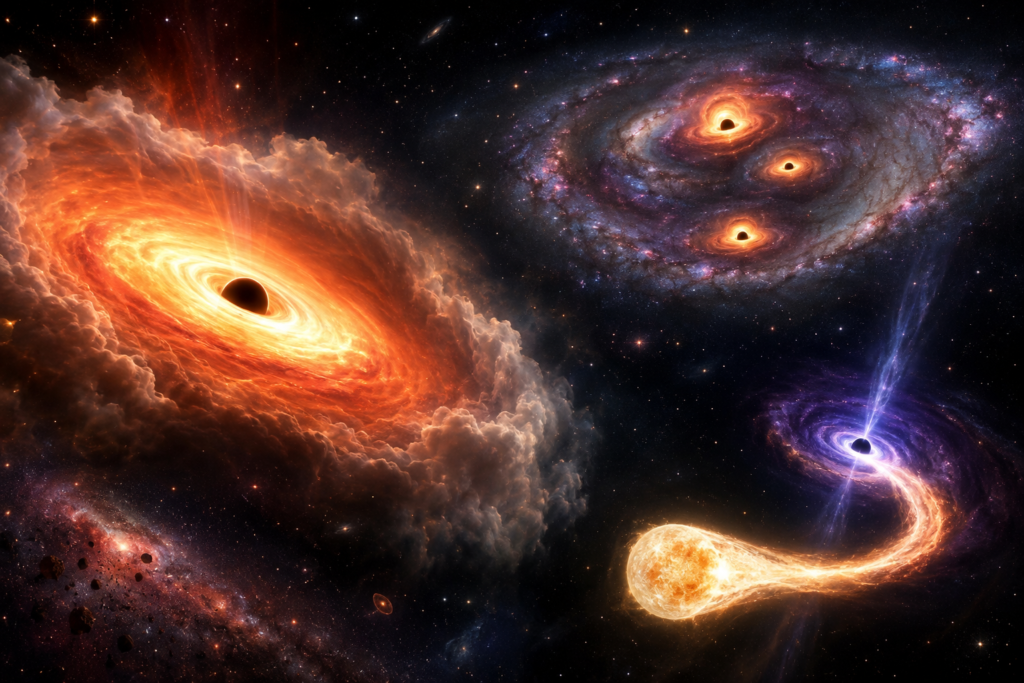
Astronomers have identified a new kind of cosmic object called a “black hole star,” a discovery published August 12 in the journal Nature. The object, named MoM-BH*-1, is a black hole roughly 100,000 times the mass of the Sun wrapped in a dense envelope of hydrogen gas the size of the solar system. It existed just 660 million years after the Big Bang, and researchers say it may explain how supermassive black holes grew so large so quickly in the early universe.
What Astronomers Found
The object was spotted through the James Webb Space Telescope’s “Mirage or Miracle” survey, led by astronomer Rohan Naidu of the University of Hawaii’s Institute for Astronomy and colleagues. It first appeared in Webb images taken in 2023 as one of hundreds of compact, unusually red points of light nicknamed “little red dots,” a class of objects that has puzzled astronomers since Webb began observing the distant universe.
A detailed look at the object’s spectrum revealed a sharp drop in brightness at a specific wavelength, known as a Balmer break. That feature typically signals dense, turbulent hydrogen gas absorbing high-energy radiation, which researchers interpret as a smoking gun for a black hole cocooned in gas rather than an ordinary star.
Unlike most little red dots, which sit inside a young galaxy, MoM-BH*-1 appears to exist largely on its own. Its light is so intense that it outshines its surrounding environment, giving scientists an unusually clean view of the black hole and its gas envelope without interference from a host galaxy. Researchers estimate it will take about 100 million years for the object to merge with a nearby young galaxy at the same distance.
The black hole is not powered by nuclear fusion, the process that fuels ordinary stars. Instead, its energy comes from matter falling into the black hole and being absorbed and reprocessed by the surrounding gas, producing a glow that mimics a star roughly 100 billion times more luminous than fusion alone could generate.
Why It Matters
Standard models hold that supermassive black holes grow gradually over billions of years. But Webb has repeatedly found black holes with millions to billions of solar masses in galaxies that existed within the universe’s first billion years, a timeline that is difficult to explain through slow, steady growth alone.
Naidu and his co-authors, including researchers from the Institute of Science and Technology Austria
, say a gas-shrouded black hole like MoM-BH*-1 could allow a relatively small “seed” black hole to pack on mass far faster than conventional models predict. If similar objects are common, they could account for many of the little red dots seen throughout Webb’s deep-field images.
The team cautions the black-hole-star interpretation is a model, not a final answer. Independent observations of more examples will be needed to confirm how common these objects are and whether they represent a genuine early stage of supermassive black hole growth.
A Second Discovery: Three Black Holes in One Galaxy
Separately, an international team led by the Max Planck Institute for Extraterrestrial Physics
reported the first confirmed detection of three actively feeding supermassive black holes within a single galaxy. The galaxy, known as J0148-4214, lies about 12.5 billion light-years away and is observed as it existed roughly 1.2 billion years after the Big Bang.
Using spatially resolved spectroscopy from Webb’s NIRSpec instrument, researchers identified three distinct black holes with masses of roughly 80 million, 2 million, and 600,000 suns. Two of the black holes sit close together near the galaxy’s center, separated by about 620 light-years, and are expected to merge within a few hundred million years. The third lies farther out, about 5,500 light-years from the center.
Researchers say the finding supports the idea that black hole mergers and interactions in the early universe helped drive the rapid growth of supermassive black holes, since multiple black holes crowded into one system can accelerate each other’s path toward merging.
A Black Hole Caught Far From Home
A third recent finding, reported in late July, shows how astronomers are also tracking supermassive black holes that have left their galaxy’s center entirely. NASA’s Neil Gehrels Swift Observatory
and the Zwicky Transient Facility confirmed a black hole more than 30,000 light-years from the core of its host galaxy, WISEA J014656.04-152214.7, located about 750 million light-years away in the constellation Cetus.
The black hole revealed itself in November 2025 when it tore apart a passing star in what astronomers call a tidal disruption event. The resulting flare briefly outshone the entire host galaxy in ultraviolet light, radiating with the brightness of about 10 billion suns, and Swift measured its temperature at roughly 30,000 degrees Celsius. Follow-up spectra from the SOAR telescope in Chile confirmed the signature as a tidal disruption rather than a supernova or an active galactic nucleus flare.
The black hole, estimated at about a million solar masses, is the farthest off-center such event ever confirmed, breaking a previous record of 2,600 light-years set in 2024. Lead researcher Robert Stein of the University of Maryland and NASA Goddard Space Flight Center said the black hole most likely originated in a smaller galaxy that later merged with its current, larger host, though a gravitational kick from a black hole merger has not been ruled out.
How Scientists Detect Black Holes
Black holes emit no light of their own, so astronomers rely on indirect evidence:
- Accretion Disks: Gas and dust falling into a black hole heat up and glow.
- Stellar Dynamics: Stars orbiting an invisible mass reveal a black hole’s presence through their motion, the method that confirmed Sagittarius, the roughly 4-million-solar-mass black hole at the Milky Way’s center.
- Gravitational Waves: Merging black holes produce spacetime ripples detected by observatories such as LIGO and Virgo.
- Gravitational Lensing: A black hole’s gravity bends light from background objects.
- Tidal Disruption Events: Revealing a black hole only when it consumes a nearby star.
What Comes Next
Researchers plan to search for more black hole stars and off-center tidal disruption events using Webb, the upcoming Vera C. Rubin Observatory, and NASA’s Nancy Grace Roman Space Telescope
, which is expected to launch as soon as August 30, 2026, and could detect up to 100 star-shredding events per year. Together, the three findings point to a more complex and dynamic early universe, one in which black holes grew, merged, and wandered through more varied pathways than earlier models predicted.
Related Reading: [Verizon Outage: Is Verizon Down? Latest Update & Fixes]