
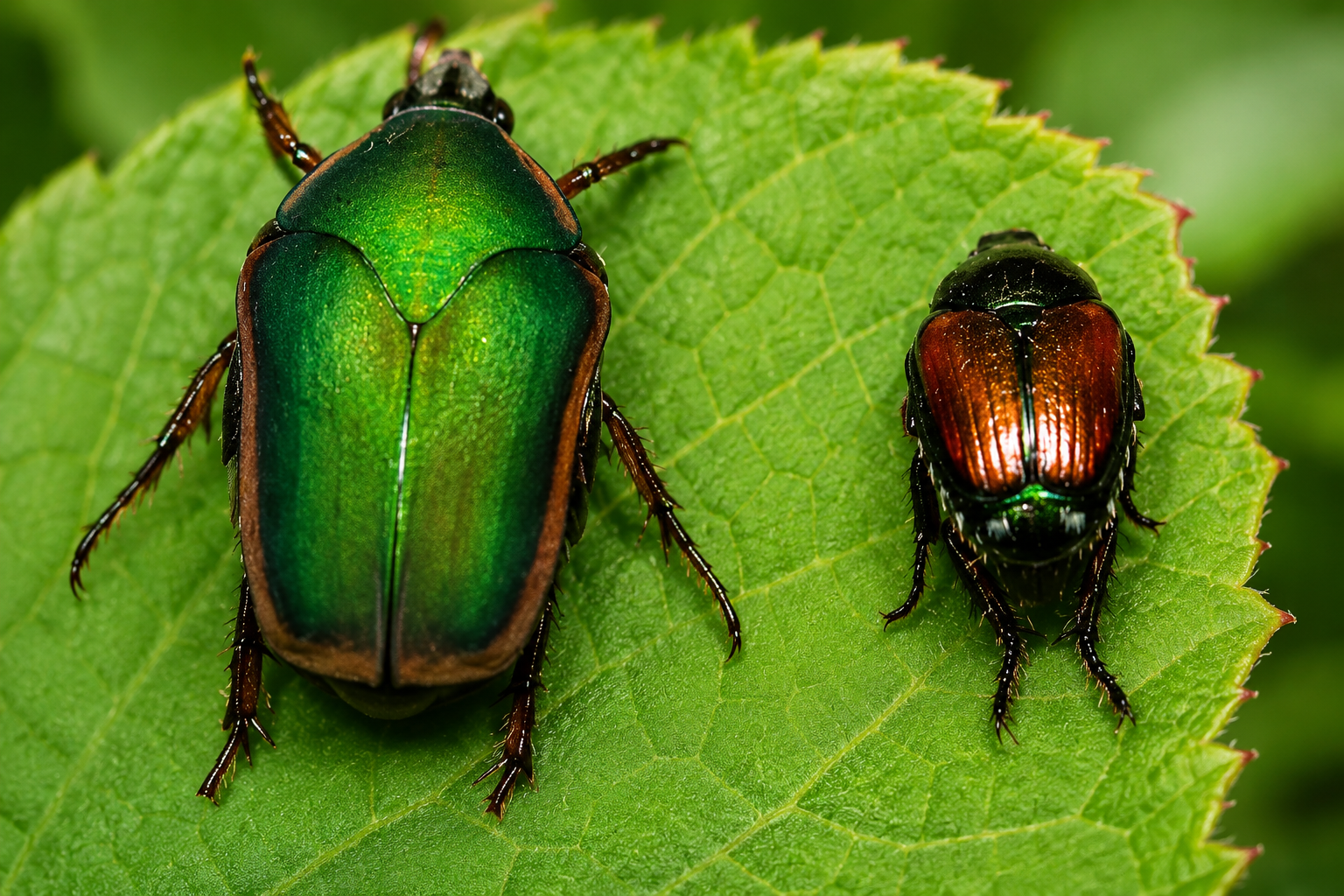
Two beetles cause most of the “what is this bug” confusion in American gardens every summer: the June bug and the Japanese beetle. The Japanese beetle is smaller, about 3/8 inch long, with a metallic green head, coppery bronze wings, and a row of five white hair tufts on each side of its abdomen, and it feeds in daytime groups that can skeletonize a rose bush in days. The June bug is larger, reddish brown to nearly black, flies clumsily at night toward porch lights, and causes only minor, scattered leaf notching.
Getting the ID right matters because the two beetles need completely different responses, and treating the wrong one wastes money or harms a harmless native insect.
The Fastest Way to Tell Them Apart
Before checking color or size, try this two-second field test: catch the beetle and turn it belly-up in your palm.
If it struggles clumsily and looks uniformly brown underneath, it’s a June bug.
If you see a flash of metallic green on the head and thorax even in dim light, and small white tufts poking out along the abdomen’s edges, it’s a Japanese beetle.
If it was flying at dusk or night and banged into a window, that behavior alone points strongly to June bug, since Japanese beetles do not fly after dark.
This single tuft check is more reliable than color alone, because some June beetle relatives, like the Green June beetle, are also metallic green and get mistaken for Japanese beetles. The tufts are the one trait Green June beetles never have.
Diagnostic Traits Compared
| Trait | June Bug | Japanese Beetle |
|---|---|---|
| Body length | 0.5 to 1 inch | About 3/8 inch |
| Body color | Reddish brown to dark brown, sometimes solid metallic green (Green June beetle) | Metallic green head and thorax, coppery bronze wing covers |
| Abdomen tufts | Absent | Five white hair tufts per side, two more at the tip |
| Flight pattern | Heavy, clumsy, drawn to lights | Steady, coordinated, active in sunlight |
| Time active | Night | Day, especially hot sunny afternoons |
| Grouping | Solitary | Clusters that grow as feeding attracts more beetles |
| Leaf damage shape | Ragged notches at leaf edges | Lace-like skeletonization between veins |
| Plant range | Mostly trees and shrubs, limited appetite | Over 300 to 400 plant species, including roses, grapes, beans |
Reading the Damage Instead of the Bug
If you never spot the beetle itself, the leaf damage tells its own story. Japanese beetles eat the soft tissue between leaf veins and leave a skeleton-like web behind, usually starting from the top of the plant where sunlight is strongest.
June bugs leave irregular chunks and notches torn from leaf edges, a messier and far less severe pattern.
This distinction matters more than color in shaded gardens, where metallic green can look dull or brown depending on the light. When in doubt, check the damage pattern first, then confirm with the tuft test on any beetle you catch.
The Underground Clue: Grub Behavior
Both beetles have root-feeding, C-shaped white grub larvae, but their depth and timing differ.
Japanese beetle grubs stay close to the turf surface and finish their life cycle in about one year, producing lawn damage that shows up fairly predictably each season.
June beetle grubs often dig deeper into the soil and can take two to three years to fully develop, so lawn damage builds more slowly and less consistently.
Pulling back a patch of loose, spongy turf and counting grubs is the most reliable underground check, since both species look similar without close inspection.
A Common Look-Alike Trap
The false Japanese beetle and the Green June beetle both get mistaken for the true Japanese beetle, but neither carries the white abdomen tufts.
If a metallic green beetle lacks those tufts, it is very likely a native Green June beetle rather than the invasive Japanese beetle, and it does far less plant damage. Confirming this before spraying insecticide protects a harmless native species from unnecessary treatment.
What To Do Once You’ve Identified It
Treatment only makes sense once the beetle is correctly identified, since the two require opposite strategies.
For Japanese beetles:
Hand-pick in early morning when they move slowly, and drop them into soapy water.
Skip pheromone traps, since research shows they can attract far more beetles to the yard than they actually catch.
Treat grubs in early summer for the best results against the following year’s adults.
For June bugs:
Adult treatment is rarely necessary since damage is minor.
Reducing outdoor lighting during peak emergence weeks cuts down on nuisance swarms near the house.
If lawn grubs are confirmed by digging a test patch, treat with a grub-specific product in fall or spring.
The single most useful habit for either beetle is checking before spraying. A five-second look for white abdomen tufts, paired with a glance at whether the beetle was active at night or in daylight, resolves nearly every mix-up gardeners run into during peak beetle season.
