
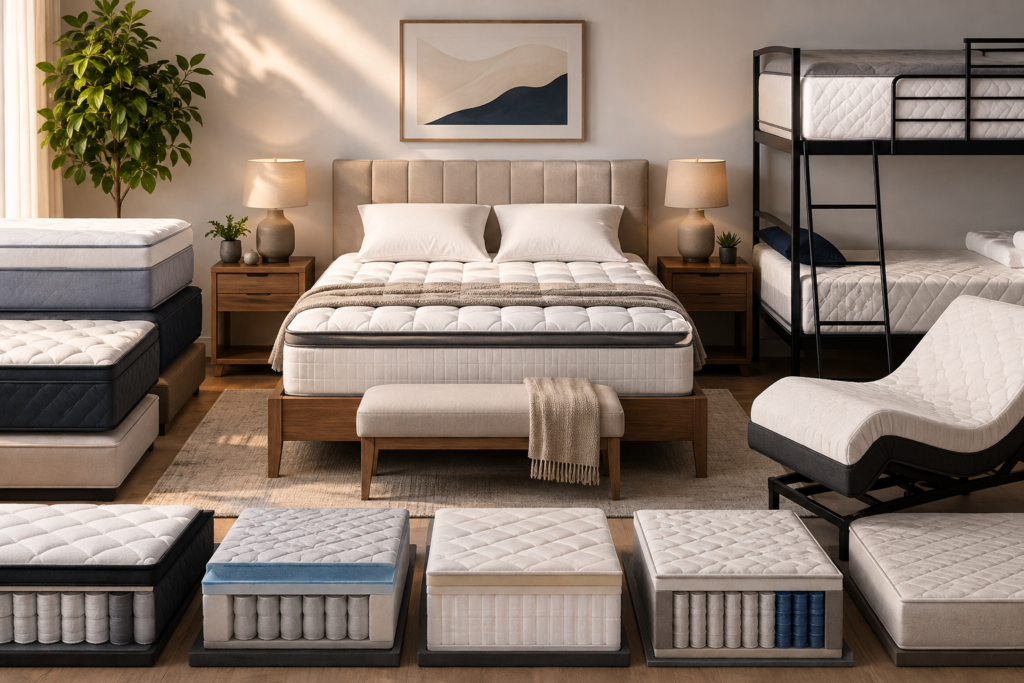
Standard U.S. mattress sizes run from Twin at 38 by 75 inches to California King at 72 by 84 inches, with Queen at 60 by 80 inches remaining the most common choice for couples and solo sleepers. Bed frames typically measure a few inches larger than the mattress itself to allow proper fit and sheet tucking. This guide breaks down every major mattress dimension, bed frame style, foundation type, and sheet size using current industry standards.
The International Sleep Products Association (ISPA) issues voluntary dimensional guidelines that most U.S. manufacturers follow, though finished mattresses can vary by about half an inch from listed measurements. Always measure an existing frame or room before buying a new mattress.
Standard Mattress Sizes and Dimensions
These eight sizes cover nearly every mattress sold by major U.S. brands.
| Size | Width x Length (inches) | Width x Length (cm) | Best For |
|---|---|---|---|
| Crib | 28 x 52 | 71 x 132 | Infants and toddlers |
| Twin | 38 x 75 | 97 x 191 | Children, bunk beds, small rooms |
| Twin XL | 38 x 80 | 97 x 203 | Tall teens, dorms, single adults |
| Full/Double | 54 x 75 | 137 x 191 | Solo adults, guest rooms |
| Full XL | 54 x 80 | 137 x 203 | Taller solo sleepers |
| Queen | 60 x 80 | 152 x 203 | Couples, most popular size |
| King | 76 x 80 | 193 x 203 | Couples wanting extra width |
| California King | 72 x 84 | 183 x 213 | Taller sleepers |
Queen remains the best-selling mattress size in the U.S., with King as the next most common choice; Twin and Full continue to serve kids, guests, and smaller rooms.
Specialty and Oversized Sizes
Several less common sizes fill specific needs beyond the standard lineup:
- Olympic Queen: 66 x 80 inches, wider than a standard Queen
- Split King: two Twin XL mattresses placed side by side, matching a King’s total width
- Texas King: roughly 80 x 98 inches
- Alaskan King: 108 x 108 inches, the largest mass-market size available
- RV and Short Queen: narrower or shorter variants built for trailers and campers
International sizing differs from U.S. norms. A UK Single mattress runs closer to 35 to 36 inches wide by 75 inches long, and a UK King is narrower than a U.S. King, so shoppers moving between markets should confirm exact centimeter or inch figures rather than relying on size names alone.
Bed Frame Types and Mattress Fit
Bed frames share names with mattress sizes but typically add two to five inches overall to accommodate rails, headboards, and footboards. The interior of a frame should closely match the mattress dimensions to avoid gaps or overhang that reduce support.
- Platform beds: Solid or closely spaced slats support the mattress directly, with no box spring needed. These sit lower, usually 12 to 20 inches high, and pair well with memory foam or hybrid mattresses.
- Panel or traditional frames: Built with a headboard, footboard, and side rails, often paired with a box spring or foundation for added height.
- Canopy and four-poster frames: Feature tall posts, often 78 to 90 inches, sometimes with an overhead structure. These need higher ceilings, ideally nine feet or more, and a larger floor footprint than a platform bed.
- Bunk and loft beds: Stack or elevate Twin or Full mattresses. A standard Twin-over-Twin frame measures roughly 42 by 78 to 80 inches and stands 60 to 72 inches tall, with ceiling clearance of at least eight to nine feet recommended.
- Daybeds and trundles: Usually built for Twin or Full mattresses and double as seating during the day, with trundles pulling out to add a second sleeping surface.
- Adjustable bases and storage beds: Motorized adjustable bases commonly come in Twin XL, Queen, or Split King configurations and raise the head or foot section. Storage frames build drawers into the base.
Room Space Requirements
According to bedroom layout guidelines from the Sleep Foundation, floor space needed around a bed scales with mattress size and the amount of walking clearance required.
| Mattress Size | Minimum Recommended Room Size |
|---|---|
| Twin/Twin XL | 7 x 10 feet |
| Full | 9.5 to 10 x 10 feet |
| Queen | 10 x 10 to 12 feet |
| King/California King | 12 x 12 feet or larger |
A Queen mattress fits most standard bedrooms, while a King generally needs a larger room to keep comfortable walking space on both sides of the bed.
Foundations, Box Springs, and Overall Height
Platform frames generally need no separate foundation. Traditional frames often pair with a box spring or a low-profile foundation, which adds 5 to 9 inches of height. The combined bed height, including the frame, foundation, and mattress, typically ranges from 16 to 25 inches for easy entry and exit. Mattress thickness alone typically ranges from 8 to 14 inches, and taller pillow-top models require deeper fitted sheets to stay secured.
Matching Sheets and Bedding
Fitted sheets are cut to match mattress width and length, plus a pocket depth suited to the mattress thickness. Standard pocket depths cover 8 to 14 inches, while deep or extra-deep sheets accommodate 15 to 18 inches or more for mattresses with toppers.
Flat sheets run larger than the mattress itself to allow for overhang and tucking:
- Twin: roughly 66 to 72 by 96 to 102 inches
- Queen: roughly 90 to 96 by 102 to 108 inches
- King: roughly 108 to 114 by 102 to 114 inches
- California King: similar length to King but a different width
King and California King sheets are not interchangeable despite the similar names, since the two mattresses differ in both width and length. Pillowcases follow standard, Queen, or King sizing, and comforters and duvets are cut slightly larger than the mattress for proper drape. Always check the pocket depth listed on sheet packaging before buying.
Related Reading: [How to Reduce Waste at Home: A Complete Practical Guide]