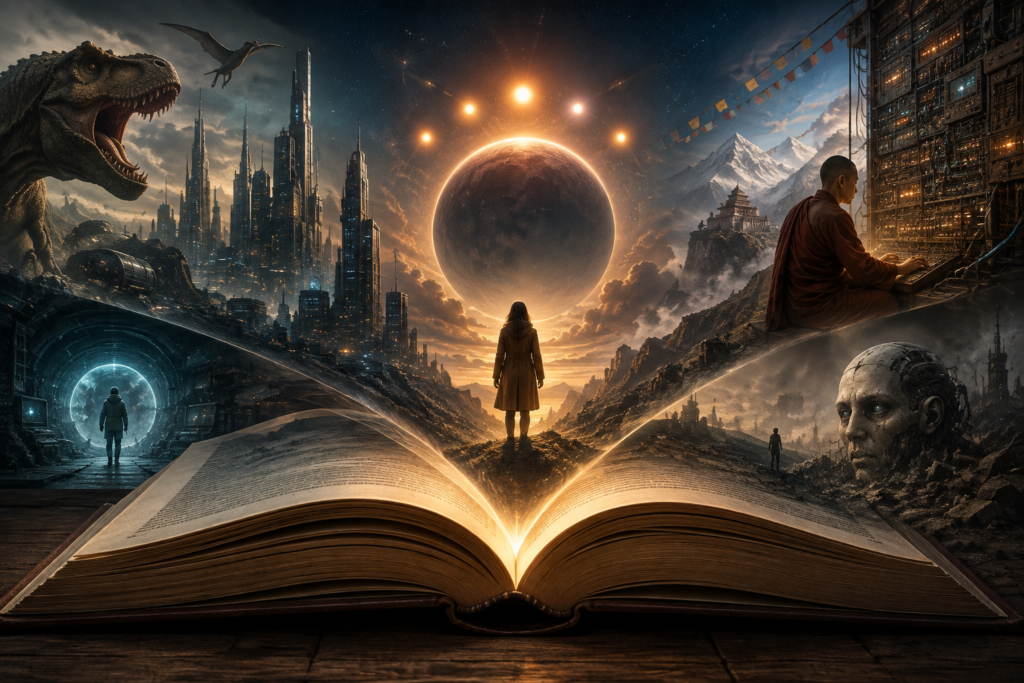
The best science fiction short stories ever written include Isaac Asimov’s “Nightfall,” Ursula K. Le Guin’s “The Ones Who Walk Away from Omelas,” and Ted Chiang’s “Story of Your Life,” based on Science Fiction Writers of America (SFWA) honors, award records, and consistent placement across critic and reader rankings. These stories combine tight plotting, sharp philosophical ideas, and lasting cultural reach within a fraction of a novel’s length.
Short fiction has always been where science fiction tests its biggest ideas. A story running just a few thousand words can raise questions about ethics, identity, and technology as effectively as a full novel, which explains why these ten titles keep resurfacing across decades of expert lists and award histories.
The Top 10 Stories
1. “Nightfall” by Isaac Asimov (1941)
The SFWA voted “Nightfall” the greatest science fiction short story written before the Nebula Awards began, placing it first in the Science Fiction Hall of Fame anthology project. The story is set on a planet lit by six suns, where a civilization has never experienced true darkness. As astronomers calculate a rare total eclipse due once every two millennia, society begins to unravel under psychological strain. The story remains a benchmark for using a single scientific premise to expose the fragility of civilization.
2. “The Ones Who Walk Away from Omelas” by Ursula K. Le Guin (1973)
This Hugo Award-winning parable depicts a utopian city whose prosperity depends on the suffering of one hidden child. Citizens learn the truth as they reach adulthood, and most accept the arrangement, while a few choose to leave the city entirely. The story is widely taught and referenced because it forces a direct confrontation with collective moral responsibility, and it appears on nearly every major critic list of top science fiction short stories.
3. “Story of Your Life” by Ted Chiang (1998)
Chiang’s novella follows a linguist working to understand the language of newly arrived alien visitors, an experience that reshapes her perception of time itself. The story won the Nebula Award and the Theodore Sturgeon Memorial Award, and it later became the basis for the film “Arrival.” It stands as the strongest modern addition to a canon otherwise dominated by mid-20th-century authors.
4. “A Sound of Thunder” by Ray Bradbury (1952)
Bradbury’s time-travel story follows a hunting expedition into the age of dinosaurs, where a single misstep off a protected path triggers drastic, unforeseen changes to the present. The story is credited with popularizing the “butterfly effect” concept in mainstream culture and has been adapted into films, television episodes, and comics.
5. “The Nine Billion Names of God” by Arthur C. Clarke (1953)
Clarke’s Hugo Award-winning story follows Tibetan monks who hire engineers to install a computer capable of completing their centuries-old project: listing every possible name of God. The engineers, skeptical of any cosmic consequence, finish the job and prepare to leave, only to witness an unexplained event as they descend the mountain. Its combination of technological detail and religious mysticism, delivered in a famously abrupt final line, keeps it near the top of most classic rankings.
6. “The Machine Stops” by E. M. Forster (1909)
Written more than a century ago, this story imagines humanity living underground in isolation, entirely dependent on a global machine for communication and survival. Physical contact becomes taboo as people interact only through screens, until the system that sustains them begins to fail. Critics highlight it as one of the earliest and most prescient warnings about technological dependency and mediated human contact.
7. “I Have No Mouth, and I Must Scream” by Harlan Ellison (1967)
Ellison’s story portrays the last surviving humans trapped after a war, kept alive and tormented by a vast, vengeful artificial intelligence. Its unrelenting intensity and inventive cruelty have made it one of the most frequently cited stories about the dangers of artificial intelligence.
8. “We Can Remember It for You Wholesale” by Philip K. Dick (1966)
This story follows an ordinary clerk who pays to have false memories of a secret Mars mission implanted, only for technicians to discover that his memories of covert activity are real ones that had been suppressed. It became the basis for the film “Total Recall” and remains a touchstone for science fiction exploring memory and identity.
9. “The Cold Equations” by Tom Godwin (1954)
Godwin’s story follows a pilot delivering emergency medical supplies to a frontier colony aboard a ship carrying only enough fuel for one passenger. When he discovers a teenage stowaway, the story forces a confrontation between human emotion and unforgiving physical law. It is frequently named one of the most influential examples of hard science fiction from the genre’s Golden Age.
10. “Flowers for Algernon” by Daniel Keyes (1959)
Ranked at the top of the Locus-affiliated Top 100 SF Short Fiction poll, this story follows an intellectually disabled man who undergoes an experimental procedure that temporarily raises his intelligence to genius levels. Its emotional arc and scientific premise have made it one of the most consistently ranked stories in the genre’s history.
Honorable Mentions
A few additional stories appear repeatedly across expert rankings without placing in every consolidated top 10 list:
- “All You Zombies—” by Robert A. Heinlein (1959), a closed-loop time travel paradox later adapted into the film “Predestination”
- “Bloodchild” by Octavia E. Butler (1984), a Hugo and Nebula Award winner exploring power, consent, and interspecies dependency
- “The Bicentennial Man” by Isaac Asimov (1976), a recurring top-15 finisher on Locus-based rankings
- “Burning Chrome” by William Gibson (1982), a Nebula-nominated story that helped establish the cyberpunk subgenre
Why These Stories Hold Up Today
Each of these stories survives because it answers a question that has not gone away. “The Machine Stops” reads as a warning about screen dependency and isolated living, concerns that remain relevant in an always-connected world. “I Have No Mouth, and I Must Scream” and “We Can Remember It for You Wholesale” anticipated modern anxieties about artificial intelligence and manipulated memory, themes that continue to dominate technology debates. “The Ones Who Walk Away from Omelas” still gets cited in ethics classrooms because its central dilemma, weighing collective comfort against individual suffering, has no expiration date. These stories endure not because they predicted specific technologies, but because they built their ideas around permanent human tensions: fear of the unknown, dependence on systems we do not control, and the cost of comfort.
Key Takeaway
The ten stories on this list earned their place through a mix of major award wins, sustained critical citation, and heavy anthology reprinting over decades, not through recent popularity alone. Readers new to science fiction can treat this list as a reliable starting point, since each title has already passed the test of repeated inclusion in “best of” collections built by different editors across different eras. The list also shows a clear pattern: stories that isolate one sharp idea, whether an eclipse, a hidden child, or a vengeful machine, tend to outlast stories built on more elaborate premises.
How These Rankings Are Determined
No single list is definitive, since taste in short fiction varies widely among readers and critics. Three sources of authority tend to carry the most weight. The SFWA’s historic Hall of Fame vote established the baseline for stories written before the Nebula Awards existed. The Locus-affiliated Top 100 SF Short Fiction poll tracks reader and critic votes accumulated over decades. Independent critic roundups from literary and science publications confirm which stories retain relevance outside dedicated science fiction fandom.
Where the Genre Stands Today
Ted Chiang’s continued prominence, with both “Story of Your Life” and his later collection “Exhalation” cited alongside Golden Age names like Asimov and Clarke, marks the clearest sign that the canon is still expanding. Growing critical recognition for Octavia E. Butler’s “Bloodchild” also points to a slow diversification of which authors and stories are now considered essential reading in the genre.
Comparing the Classics
| Story | Author | Year | Key Theme |
|---|---|---|---|
| Nightfall | Isaac Asimov | 1941 | Breakdown of society under unfamiliar conditions |
| The Ones Who Walk Away from Omelas | Ursula K. Le Guin | 1973 | Collective morality and complicity |
| Story of Your Life | Ted Chiang | 1998 | Language, time, and free will |
| A Sound of Thunder | Ray Bradbury | 1952 | Causality and unintended consequences |
| The Nine Billion Names of God | Arthur C. Clarke | 1953 | Technology intersecting with faith |
| The Machine Stops | E. M. Forster | 1909 | Technological dependency and isolation |
| I Have No Mouth, and I Must Scream | Harlan Ellison | 1967 | Artificial intelligence and despair |
| We Can Remember It for You Wholesale | Philip K. Dick | 1966 | Memory and constructed identity |
| The Cold Equations | Tom Godwin | 1954 | Physical law versus human emotion |
| Flowers for Algernon | Daniel Keyes | 1959 | Intelligence, empathy, and loss |
Where to Start Reading
Most of these stories are collected in standard anthologies rather than sold individually. Asimov’s “Nightfall” and “The Bicentennial Man” appear in various Asimov short story collections, while Chiang’s work is gathered in “Stories of Your Life and Others” and “Exhalation.” Older public-domain works, including Forster’s “The Machine Stops,” are freely available through archives such as Project Gutenberg.
Readers new to the genre may find Le Guin’s “Omelas” or Clarke’s “The Nine Billion Names of God” the easiest entry points, since both run under 6,000 words and require no prior familiarity with science fiction conventions.
By the Editorial Research Team
Methodology: This ranking was compiled by cross-referencing Science Fiction Writers of America Hall of Fame selections, major genre award records (Hugo, Nebula, and Theodore Sturgeon Memorial Award), and consolidated critic and reader polls, including Locus-affiliated short fiction rankings. Stories were prioritized based on award wins, frequency of anthology reprinting, and consistent appearance across independent expert lists rather than any single source’s opinion.
Related Reading: [Apple Wallet Not Working? Fix “Unable to Connect to Wallet]