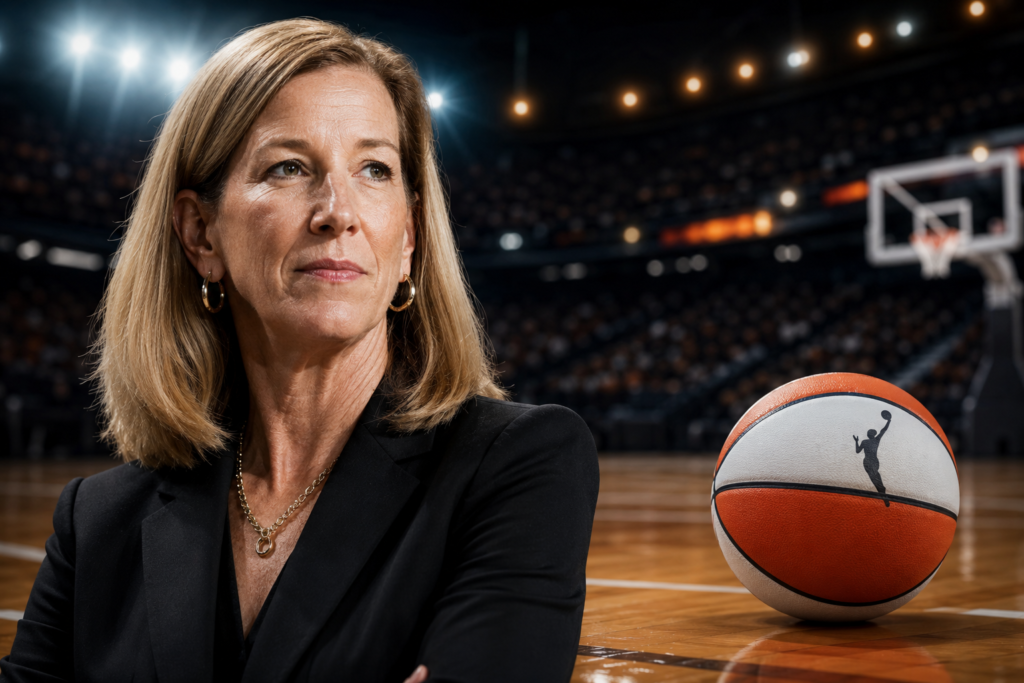
Cathy Engelbert, the WNBA’s first commissioner, is facing the most consequential controversy of her seven-year tenure after two former NBA players declared themselves eligible for the 2027 draft by saying they identify as women, reigniting a national debate over transgender athletes in women’s sports. Engelbert, a former Deloitte CEO who has overseen record commercial growth in the league, sent teams a memo on August 8, 2026, acknowledging the issue but stopping short of stating a clear eligibility policy.
From Big Four Boardroom to WNBA Command
Catherine M. Engelbert was born November 14, 1964, and grew up in Collingswood, New Jersey. Her father, Kurt Engelbert, played basketball at St. Joseph’s University and was drafted by the Detroit Pistons in 1957, an influence she has cited in shaping her competitive drive. She attended Lehigh University, where she played basketball under Hall of Fame coach Muffet McGraw and served as team captain in both basketball and lacrosse, graduating in 1986 with an accounting degree.
Engelbert joined Deloitte the same year and spent 33 years there, making partner in 1998. In 2015 she was elected CEO of Deloitte, becoming the first woman to lead a Big Four accounting firm in the United States. Revenue grew more than 30 percent during her tenure, surpassing $20 billion, before she stepped down in 2019.
The WNBA named Engelbert its first commissioner on May 15, 2019, replacing the previous title of league president. She officially took over on July 17, 2019. Her early tenure included creating the 2020 “Wubble,” a single-site bubble in Bradenton, Florida, that let the league complete a full season safely during the COVID-19 pandemic. She also sits on the boards of McDonald’s Corporation and Royalty Pharma and serves on the USGA Executive Committee.
A League in Hypergrowth
Under Engelbert, the WNBA has entered what league observers call a hypergrowth period. Franchise valuations climbed sharply, and between 2024 and 2025 the league recorded a 180 percent year-over-year growth rate following Caitlin Clark’s arrival, more than double any prior year-over-year growth mark set by a professional sports league. The league expanded to new markets including the Golden State Valkyries, Portland, and Toronto, with active planning underway for future franchises in Cleveland, Detroit, and Philadelphia.
A new collective bargaining agreement, signed in March 2026, delivered the league’s first core of million-dollar player salaries and raised the salary cap. Engelbert has described the deal as balancing higher player compensation against continued league investment, though the 2025 negotiations exposed what has been described as a central tension between rapid revenue growth and player pay that had lagged behind it.
At the league’s All-Star Game press conference in Chicago on July 25, 2026, Engelbert highlighted this growth while announcing a centralized instant replay center set to launch for the 2027 season, using NBA facilities in Secaucus, New Jersey, alongside new cameras installed in arenas that lack them.
The Transgender Eligibility Controversy
The current crisis traces back to comments Indiana Fever guard Sophie Cunningham made in a July 2026 interview, in which she voiced support for barring transgender athletes from women’s sports. Her remarks triggered small rallies and protests outside Fever road games in Seattle, Portland, and Minnesota. Cunningham later said she wants the focus to return to basketball amid the ongoing tension.
The debate escalated on August 8, 2026, when former NBA players Enes Kanter Freedom and Royce White both declared themselves eligible for the 2027 WNBA Draft, saying they identify as women. White said he identifies as transgender “sometimes, for purpose of basketball,” and indicated he would reconsider his declaration only if the league issued a definitive statement on eligibility.
That same day, Engelbert sent a memo to team presidents, general managers, and coaches, obtained by the Associated Press. She wrote that she expected the topic to “continue to receive significant attention” and thanked staff for handling media questions “with thoughtfulness and professionalism.” She outlined the league’s approach around three points: the WNBA will handle the issue “thoughtfully, respectfully, and in alignment with the longstanding values of our league”; player eligibility rules are collectively bargained rather than set unilaterally by the league office; and preserving competitive integrity remains a top priority. She called the topic “complex and nuanced” and said the league would hold listening sessions for team leaders and continue talks with the Players Association.
The memo confirmed that a task force of team presidents and general managers would discuss the issue further at a previously scheduled meeting the following week.
What the Rulebook Actually Says
The WNBA’s collective bargaining agreement, signed in March 2026, states in Article XIII, Section 1(a): “Only players who are women are eligible to play in the WNBA.” The 409-page document does not define the terms “woman” or “women,” and the words “transgender” and “gender identity” do not appear anywhere in it, even though the agreement defines dozens of other terms in detail. The league has not issued a public policy clarifying eligibility criteria related to gender identity or sex assigned at birth.
Reaction Across the League
The WNBA Players Association released a statement the same day emphasizing diversity and inclusion while saying the union “will not be used as political pawns.” The statement read in part: “Hate, abuse, and demonization of any person or group of people, including transgender people, only fuel fear, division, and harm. We will continue to have hard conversations.”
Reaction split sharply. NBA veteran Kyle Kuzma criticized the league’s decision to route the matter through a task force rather than take a firmer stance. Minnesota Lynx coach Cheryl Reeve came out in support of transgender inclusion, saying, “We need to protect trans kids. To me, it’s a human-rights issue. Every kid has a right to sports.” Seattle Storm center Stefanie Dolson also voiced support for inclusion.
Mounting Pressure on Engelbert’s Leadership
The transgender debate has landed amid broader scrutiny of Engelbert’s leadership. She is the second-longest tenured person to hold the WNBA’s top job. At her July 25 press conference, she faced repeated questions about whether she would remain commissioner into the 2027 season and did not give a direct answer, saying instead, “I am so blessed to be at the helm of this league during this incredible hypergrowth.”
Criticism intensified after Phoenix Mercury forward Alyssa Thomas said she had not heard directly from Engelbert following a wave of death threats and online abuse directed at her team, though a league source said the commissioner had exchanged texts with Thomas and offered to speak by phone. Days earlier, a crisis management expert told reporters he would advise Engelbert to “exit stage right” given the accumulating criticism over her handling of player safety and communication.
Despite the criticism, the league’s underlying business metrics, including attendance, media rights value, and franchise expansion, have continued to grow, which is why coverage of Engelbert’s tenure has increasingly framed her position as an inflection point rather than a settled matter.
What Comes Next
The task force meeting, scheduled for the week of August 11, 2026, is the next concrete step. Engelbert has committed to continued listening sessions with team leaders and ongoing dialogue with the Players Association, but has not set a public deadline for a formal eligibility policy. Because the collective bargaining agreement does not explicitly define who qualifies as a woman for the purposes of eligibility, any policy clarification would likely require negotiation with the union rather than a decision made solely by the league office.
Related Reading: [Johanna Leia: Drake’s Ex & Mom Behind Landmark NCAA Case]