
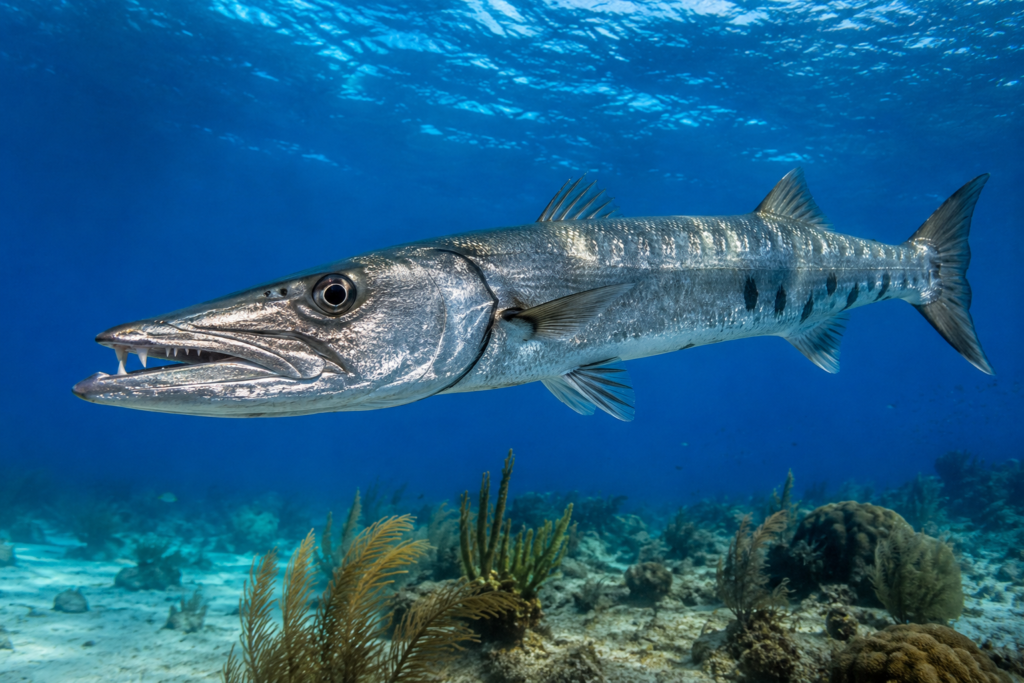
A barracuda is a large, predatory saltwater fish in the genus Sphyraena, family Sphyraenidae, recognized by its torpedo-shaped body, protruding lower jaw, and rows of blade-like teeth. Roughly 20 to 30 species exist worldwide, ranging from smaller forms under two feet to the great barracuda, which can exceed six feet and 100 pounds. These fish live in tropical and subtropical coastal waters and rank among the ocean’s most efficient ambush predators.
Physical Characteristics
The great barracuda, Sphyraena barracuda, is the most recognized species and the largest in its genus. It has a streamlined, cylindrical body covered in small scales, with a pointed head and a jutting lower jaw that creates a visible underbite.
Its mouth holds two distinct rows of teeth: smaller, tightly packed outer teeth for cutting, and larger, dagger-like inner teeth for gripping. This dentition is built for seizing and slicing fast-moving prey rather than crushing it, producing a clean shearing wound when the fish bites.
Coloration runs blue-gray to greenish on top, fading to silvery sides and a white or pale belly, often with dark bars or spots along the lower flanks. Two widely separated dorsal fins and a forked or crescent-shaped tail fin give the fish rapid acceleration from a standstill.
Adult great barracuda commonly measure 2 to 4 feet and weigh 5 to 20 pounds, though exceptional individuals reach 5 to 6 feet and can weigh more than 100 pounds. The hook-and-line record stands near 103 pounds for a fish about 5.5 feet long. According to the Florida Museum’s Great Barracuda profile, scale analysis indicates these apex predators can live up to 18 years in the wild.
Habitat and Range
Great barracuda inhabit tropical and subtropical seas worldwide, roughly between 30 degrees north and south latitude. They are common in the western Atlantic from Massachusetts to Brazil, and also occur in the Gulf of Mexico, the Caribbean Sea, the eastern Atlantic, the Indo-Pacific, and the Red Sea. They are rare or absent in the eastern Pacific.
Adults typically stay at or near the surface, but data compiled by FishBase shows they can range to depths of about 100 meters across open marine waters. Younger fish shelter in mangroves, estuaries, and shallow seagrass beds for protection, with some tolerating brackish water early in life. Adults are usually solitary or found in small groups, while juveniles often gather in larger schools.
On reefs, great barracuda are frequently seen holding motionless in the current, a stance that can unsettle divers encountering the fish for the first time.
Diet and Hunting Behavior
Barracudas are strict carnivores and opportunistic ambush hunters. Their diet includes smaller fish such as mullets, anchovies, herrings, jacks, grunts, snappers, and groupers, along with occasional cephalopods like squid and, less commonly, shrimp.
Hunting relies heavily on keen eyesight. The fish often holds still near reef structure, then launches forward in a short, explosive burst of speed to seize prey before it can react. Smaller fish are swallowed whole, while larger prey is sliced into pieces using powerful jaw bites.
Human Interactions
Attacks on people are rare and almost never fatal, typically involving a single quick strike rather than sustained aggression. Barracudas are generally not aggressive toward humans unless provoked or mistaken for prey. Most bites happen when a barracuda mistakes a shiny object, such as jewelry, a watch, or diving gear, for the flash of a struggling fish, particularly in murky water or during spearfishing activity. Barracudas may also trail or observe divers out of simple curiosity rather than predatory interest.
Basic precautions can lower the already low risk of an encounter:
- Avoid wearing shiny jewelry, metallic watches, or high-contrast reflective gear while swimming or diving
- Remove speared fish from the water promptly, since blood and movement can attract barracuda
- Keep a calm, steady distance rather than cornering or provoking the fish
Bioaccumulation and Toxin Accumulation in Apex Predators
As apex predators in coral reef ecosystems, large barracudas sit at the top of a complex marine food web. This ecological position makes them a primary example of biomagnification, the process where naturally occurring compounds accumulate in increasing concentrations at higher trophic levels.
The process begins at the base of the food web with microscopic reef-dwelling dinoflagellates (primarily species within the genus Gambierdiscus), which produce organic ciguatoxins. Herbivorous reef fish consume these microscopic organisms while grazing, absorbing trace amounts into their tissues. As great barracudas prey on these smaller fish throughout their lifetime, these lipid-soluble compounds accumulate in their muscle tissue and organs, particularly in larger, older individuals exceeding three feet in length.
Because these biological compounds are chemically resilient and heat-stable, they persist in the marine food chain indefinitely. For this reason, marine biologists and fisheries researchers frequently monitor large predatory reef fish to study trophic transfer and track the overall ecological health of tropical coral reef systems.
Conservation Status
The great barracuda is listed as Least Concern by the International Union for Conservation of Nature, and its global population is considered stable and widespread. Despite this overall status, localized declines have been reported in some regions, including parts of the Caribbean and Florida, prompting discussion of tighter catch limits in affected areas.
Fishing pressure and habitat changes remain factors monitored in regions with documented local declines. As a mid-to-top predator, the great barracuda plays a significant role in structuring reef and coastal fish communities by regulating populations of smaller fish species.
Species Overview
| Trait | Detail |
|---|---|
| Family | Sphyraenidae |
| Genus | Sphyraena |
| Number of species | Approximately 20 to 30 |
| Largest species | Great barracuda (Sphyraena barracuda) |
| Maximum size | Up to 6 to 8 feet, over 100 pounds |
| Maximum lifespan | Up to 18 years |
| IUCN status | Least Concern |
| Range | Tropical and subtropical Atlantic, Indo-Pacific, and Red Sea; rare in eastern Pacific |
Barracudas remain a frequent subject of interest for divers and anglers due to their striking appearance and hunting behavior. Current evidence shows they are effective predators whose interactions with people are limited and largely preventable through basic awareness of their feeding triggers.
Related Reading: [Nature & Wildlife – TrendingLiberty]